Showing posts with label ynomy. Show all posts

Wednesday, June 3, 2020

FREE month

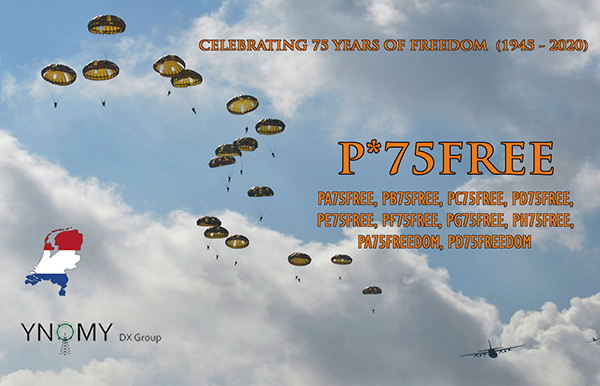
Last month I spent more time on the radio than the preceding twelve months combined. I was on the air as one of ten stations with a special call in the P*75FREE(DOM) range to commemorate the end of WW2 in The Netherlands in May 1945.


Planning the event at the end of last year we had ideas to be active as a group or subgroup during the month with a large event from a war museum. They were happy to accommodate us a whole weekend. However COVID-19 changed all that. 

Initially I went out /P alone to a couple of PAFF nature reserves but as the month progressed we decided to do a smaller group activity with three operators from a nature reserve (PAFF-0168). We were able to set up two stations - one 40m and one 10 to 20m using the portable hexbeam. We changed the latter into a 60-80m station in the evening.


Hexbeam set up in a nature reserve with PD75FREE, PG75FREE and PH75FREE running two stations

Through email and Telegram chat the FREE stations kept in touch on the progress, the conditions and notable experiences. It is nice to see how working as a team motivates one to be more involved and spend more time behind the radio. Each participant made different choices based on preferences (like more or less digi) and set-up.

Another motivating factor were the most active chasers that tried to find us on each band and mode and even contacted us by email or Facebook to share their enthusiasm and look for opportunities to work us with OH2YV as the most striking example. His dedication was extraordinary. He finished first by a stretch only using phone and CW (so missing all possible digi points most other chasers did collect). 


All in all we made 25.000 QSOs with 13.000 stations. I was not the most active by a long stretch but still made a nice amount of contacts spread over the bands and modes (giving serious chasers a chance to accumulate points). There was a nice bit of sporadic E in the second half of the month, allowing for short skip on 20 and 40 but also openings on higher bands up to 2m.


In three pictures an idea of my activities (star = digi, dot = phone/cw):
VHF and high HF: 2/4/6/10/12/15m - sporadic E fun within EU

17/20m gave both Es and some F2 DX

Low band (30/40/60/80/160m) throughout EU and one DX on 40m to PY
To be able to work the chasers on low bands and further than the first hop (DX was challenging), I went out one last time in the last weekend of our activity to a piece of wasteland where I could set up an antenna for 160m. PD7YY joined me to see if we could work DX on 40m as well - and we did with PP7DX making it all the way.  

18m pole with low band wire antenna's and our YNOMY flag

After finishing collecting all data and producing 400+ awards the following challenge is QSL-ing all our chasers. For now the radio will enjoy some rest - probably until I go on holiday. I hope to be able to go camping in France - like previous years. We'll see how things progress in this peculiar period.

Friday, December 14, 2018

Looking ahead at 2019

Discussing plans for next year with my YNOMY team brought me to ponder what radio-activities I would be going to undertake. I have rarely been in the vicinity of my radio this year and I think next year will be the same. Conditions are such that I can hardly make any interesting contacts with the setup I have at home. At the same time my work commitments limit the /P opportunities. I hope to be able to go out some more to activate some nature reserves or castles than I did this year. Perhaps I will re-use some of the special calls I used in 2017 (P*44FF). 

As I look ahead, I can see three highlights on the horizon: 

1. YNOMY expedition
LX and HB0 were so much fun that we have decided to spend another weekend in May together in some relatively remote place activating nature reserves. We have some ideas where to go to but more details will follow once we finalise our plans. 

2. COTA-PA special event
The world castle award program turns 10 years in June. The COTA-PA program - the local castle award program for PA - will participate in the festivities. I am currently organising a group of operators to use a number of special callsigns in June for the celebration.

3. Summer holiday
The summer holiday always gives me time and opportunity to go out /P. I will be in France this summer and expect to activate some nature reserves there.

No PACC
Not on this list is the PACC - our national contest. I have been participating with my YNOMY team for the last 5 years and we won the last 3 times. Looking ahead at 2019 we found that we lacked motivation to go for a fourth win. 
We did not make any changes to our field day setup - so there is nothing to test and learn. As it is a field day setup and as we enter the contest to win, it is a considerable effort. Repeating last year is just not enough fun for us to put that much effort in.
We might return to the contest in a couple of years if conditions improve - as that will change the contest dynamics and gives us an opportunity to improve on our own highscore (in points).

Perhaps the end of the year will give me an opportunity to go /P for a change. At the moment planning the May expedition is the major source of radio fun. 

Thursday, April 26, 2018

PACC 2018: we did it again

Today the results of the PACC contest came in. Amazingly my fellow team members of YNOMY and me managed to score a hat-trick: we secured the first place for the third year in a row using the call PG55G this time.

The recipe has been the same these three years: using an empty campground we set up wire antennas on Friday for 40, 80 and 160, adding a portable hexbeam on Saturday morning and then have radio fun for 24h using a well prepared plan constantly updated by live experiences of the band conditions. The two phone operators get a few hours of sleep while our poor cw operator only gets a few opportunities to nap when the phone operators are going.

We are always looking for improvements but this year the only upgrade was the coax we used (as we ran into problems with the coax we used last year). It gets harder and harder to squeeze out more while maintaining our field day concept. 


Tried and trusted hexbeam for 20m (and 2 QSO on 15m)

Wednesday, April 11, 2018

Preparing for a dxpedition to HB0

Last year May I went to LX with PD7YY and PG8M for a weekend to activate 7 different LXFF nature reserves. With the help of the LXFF coordinator we managed to get hold of a nice special call LX44FF.

Perfect conditions @LX in 2017
We were blessed with perfect weather and some Es conditions on 20m. We had a great time that weekend and managed to log far more contacts than we anticipated. We were thinking along the lines of the PACC contest (24h) - 1700 QSO or so - but we ended up with over 2100 QSOs. 

With this experience we of course discussed going on tour again this year. Moving up the DXCC wanted list we considered Bouvet for a moment and had a good look at Scarborough Reef but settled for Liechtenstein.

Picture of the hotel in HB0 - I hope the weather will be like that for us
We will be staying up in the mountains in a nice looking hotel - an upgrade from the caravan we occupied last year - and we will have a bit more time as we are traveling on Friday and Monday. The weather is a big unknown as are the conditions. In general the conditions on HF are poor but that was the case last year as well. We can only hope we will have some Es conditions (bringing a 2m and 6m antenna just in case). Then there is the influence of the mountains that will be a new one for us. Some of the locations we will be active from are on a mountain side. That will undoubtedly influence the signals in some directions.

HB0 is very strict in giving out callsigns so we will not have the benefit we had in LX of a nice short special call. Instead we will be using HB0/PG8M and HB0/PH0NO (switching between those when we move from park to park). Like last time we will be making special awards available for our chasers (details here: http://www.ynomy.nl/2018/03/ynomy-goes-hb0-wwff-expedition.html)

Preparations are ongoing. Several ham radio news sites / letters have been informed and we are checking and completing our gear. We will be taking three radios (one specifically for VHF) with batteries for one day and a whole bunch of different antennas including end fed wires, dipoles, a hexbeam and a VHF yagi with the necessary masts. We will have one mobile amplifier for the HF phone station with its own fat battery.

Now we will have to figure out how to fit all of that and three operators in one car...

Sunday, April 9, 2017

YNOMY LX-pedition planned for May

In preparation of our expedition to BS7 or P5 sometime in the future, YNOMY DX group has planned its first group expedition. So far we have all been active from various places outside of PA individually. As a contest team we have shown to be able to work together for a couple of years already with rather acceptable results.

So now we are off to our first team expedition on May 20 and 21. We chose LX as a convenient location and we chose WWFF as the focus of our operation. Working together with the LXFF coordinator, Mill LX1CC, we have made some draft plans and acquired a special callsign to be used for this expedition: LX44FF.


Our goal is to work as many chasers as we can from Saturday morning till Sunday evening using multiple stations both on phone and CW on whatever band is open between 80m - 2m. We will also issue an award to the most active chasers - check out: LX44FF Award

Really looking forward to a whole weekend of LXFF. Let's hope conditions are acceptable or better.

Monday, February 20, 2017

PACC 2017 - amazing results with our field day station

This year I participated for the 4th time in the PACC contest together with the other two members of the highly exclusive YNOMY DX club (3 members). We again used a temporary station with wire antennas on a campsite, knowing that low tech and high spirits are a good combination in this contest.

We had set ourselves a challenge by winning the PACC last year in the multi-one category. It is difficult to be satisfied with anything less than first place now. However we downplayed our expectations by aiming for a top 3 position.

We upgraded our antennas slightly with the use of a higher Spiderbeam pole for the low band antennas. The biggest one is 26m - a nice upgrade from the 18m we used previously for 160 and 80. It is quite a challenge to set up in the field but we managed to get it up in one try. We used the 18m pole for the 40m inverted V. Another upgrade as it was on a 12m high pole in 2016.

We spent the Friday afternoon before the contest weekend setting up the low band antennas in between sheep  - more info and pictures of what the set up looked like including the curious sheep: http://ynomy-dx.blogspot.nl/2017/02/pc55c-pacc-2017-in-pictures.html

In the weeks and days before the contest we made our operating plan using the data from our 2015 and 2016 logs and available online log data of the last few days before the contest to get a hint of the opening times of bands to various directions. This plan was our rough operating guide that was constantly revised using our experiences of how busy each band was and online sources of contact info (clusters, online monitors, online log traffic, etc).

Working in shifts (at least two of us were, our unlucky CW operator had to be on standby for 24h) we kept a steady rate of QSOs going. The high bands were really nothing like last year so the multipliers were more difficult to collect and the Sunday morning was definitely less exciting than last year when there was a local skip with high QSO runs in the last 2 hours. Now it was a far slower pace.

However, all in all we managed to make more contacts than last year - much to our own amazement: 1735 QSOs with 1705 qualifying for points. We also managed to minimise the impact of the poor top bands by scoring more multipliers on the low bands. Up to the last two hours it even looked like we would be able to top our score of 2016 but then the pace slowed down.

We came close but we did not pull that stunt. Last year our pre-evaluation score was 590k (558k after evaluation). This year our pre-evaluation score is 568k.

Considering band conditions we are very pleased with the results. We understand from other participants that generally the contest was perceived as far more challenging than last year. Looking at the preliminary results we can count on a top 3 position.. probably a high top 3 position :)


Saturday, May 28, 2016

Great news: first place in PACC

Today I received incredible news. Together with two friends I secured the first place in the Dutch ham radio contest PACC using the special call PA55A.

We - PD7YY, PG8M and myself (aka YNOMY DX Group) - entered the contest for the third time. With good preparation, dedication, lots of fun and some suffering (freezing our hands off in rain and wind) we scored the highest amount of QSOs and multipliers of all single tx contestants.

I am really pleased we managed to pull this off with the minimal means we used - a temporary stations with wire antennas on a desolate campsite.

This goes to show that state of the art equipment is not the key differentiator.

Nice :)

Wednesday, March 30, 2016

PACC 2016 with YNOMY

Studies have taken a lot of my spare time the last 12 months, so there is not a lot of radio news to share. I did however participate in PACC 2016 contest with the YNOMY crew.

We participated with the special call PA55A from the same camping ground we used in 2015. That year we finished second and were comfortably warm during the contest (as opposed to our first attempt in 2014) - good reasons to go back to the friendly camping owners. Although they look at us warily when they see us struggling setting up all those wires in rain and wind, we are most welcome to use their grounds.

The setup we used was comparable to 2015 with separate wire antenna's for 160m, 80m and 40m - using three fiberglass poles - and a hexbeam for 20m, 15m and 10m. We used one radio and a small solid state amplifier that gave us about 300w peak on most bands.

Another thing that was comparable to last year and the year before was the weather. It was cold, windy with some rain and snow. The pictures below give you an impression of the state the field was in.

It does look like we did well. We learnt our lessons from our attempts in 2014 and 2015. The preliminary results (from the log robot) place us in #1. Not bad at all. Now we have to keep our fingers crossed that we did not make any major mistakes. Last year we had very few errors. So let's hope the contest turns out to be comparable to last year on this level as well.

Muddy field - probably good for the reflection of waves though....


In the end everything was covered in mud - not just the shoes


Saturday, June 27, 2015

Second place in PACC contest

Today the PACC results were published in the Dutch ham magazine Elektron. It turns out that we (YNOMY dx group) managed to secure second place in the multi operator single TX category only a few contacts away from the first place.

As this was our second serious attempt in this contest (or for that matter any contest) I am really pleased with the results.

The fact that we work from a temporary location where we build up our complete station from the ground with simple means just for the contest weekend makes this result even more pleasing.

We have set ourselves a real challenge for next year...

Saturday, April 11, 2015

Celebrating 70 years of freedom with Special Event Stations

Within the YNOMY DX Group an idea was born at the beginning of this year to place special attention on this year's WW2 liberation celebrations as we have been living in peace here now for 70 years. 

70 years ago the allied forces liberated The Netherlands from Nazi rule, ending the second world war five years after it started. The southern part of The Netherlands was liberated in the autumn of 1944, while the northern part was only liberated in the spring of 1945.

On May 4, 1945 the German forces formally capitulated to the British Field Marshall Montgomery. The capitulation was effective the next day.

We therefore celebrate the end of WW2 for the whole of the country on May 5 every year ("bevrijdingsdag").

We were thinking of activating a range of special calls during the month of May with a group of operators. The range P*45FREE (PA-PH) was chosen after some debate. We also planned a group activity in the middle of the month with a special group call PA45FREEDOM.

We asked around and were able to organise a team of 9 operators that were supportive of the idea and willing to play a role in it by applying for and activating one of the special calls. The team consists of PA1WBU, PA3BAS, PA3FYG, PB7Z, PD7YY, PE1BVQ, PE4BAS, PG8M and myself.  

So we are moving from an idea to a whole range of special event stations that will be active during the month of May 2015.

In the mean time we have designed a special QSL card and are in the process of designing an award. This electronic award can be obtained free of charge when an OM or SWL has collected 45 points. Each P*45FREE counts for 9 points and the PA45FREEDOM call counts for 18 points towards the award.

Hope you will have a chance to work several of our stations.


Wednesday, February 25, 2015

PACC results visualised

For me data makes (far more) sense once it is visualised. So I spent some time with our PACC log data to transform it into pictures.

The easiest way of course is by totaling numbers of QSO per time slot, band and / or mode. You can display this in all sorts of nice graphs.

There is another way to do it, and it is one I really like: showing the actual QSOs mapped on the planet earth. This took quite some time as the N1MM logger we used during the contest does not log / retrieve the location of the station worked. Using HRD LogBook as intermediate I retrieved this data from QRZ.com.

Now with some minimal programming I was able to show the contacts plotted on the globe per time slot, per band and per mode. I made several maps with different segmentations of the data.

I liked this animation I made best - it shows our progress over time (with 1 hour increments). The colors of the data points represent the bands and the shape represents the mode used.


Sunday, February 22, 2015

PACC 2015 - experiences of the YNOMY crew

Cross-posted from the YNOMY blog site
YNOMY is a team of 3 active OMs from around Arnhem - PD7YY, PG8M & PH0NO

Pre-contest preparation
We prepared ourselves a bit better than last year (which already was a lot better than the first year). We got ourselves a nice temporary special call PE55E and we constructed and tested a number of different wire antennas well before the contest (last year M was still working on the 160m antenna a few hours into the contest).

Pre-contest modeling of our wire antennas

M had arranged a proper location at a camping ground near to where he lives and - importantly for this contest - in our province of Gelderland. The place definitely was an upgrade of the cold and windy hut we were in last year. It even featured WiFi so we had online cluster info in N1MM.

Our shack during PACC 2015

M started the installation of the antenna park together with his station manager on Friday. They installed the three main poles - 12m, 18m and 12m high - that were holding the wire dipoles for 160m (supported by all three poles), 80m (inverted v from the center pole) and 40m (inverted v from the nearest pole).

Low band wire antennas

We tested this setup before (more info in this post). Modelling showed this setup results in more gain on 160m and less gain on 40m than last year. As we would be running 3 to 4 times the power of last year on the low bands we weren't too focused on getting the maximum gain though.

Final preparations 
Saturday morning NO and YY arrived to complete the contest station,  adding an end fed for 20m, a hex beam for 20-15-10m and a yagi for 10m. As NO had to leave Sunday morning before the end of the contest - taking the hex and the yagi - we set up an extra 5/8 vertical for 15m we built and tested just 2 weeks before the contest.

Our beams: portable hexbeam and home brew 3 element yagi

When we finished setting up the station we had 7 antennas at our disposal - quite an impressive set-up for a temporary station. We were running 300-400 watts PEP into them via an icom 756P3 hooked up to a pc running N1MM.

Contest operation
We manned the station for 24h by sleeping in shifts. The camping provided us with two extra sleeping places conveniently located outside the noisy shack.
M was our CW operator while YY and NO took care of the phone contacts.

M on CW logging in N1MM with YY following the proceedings closely

As the weather was much friendlier than last year we had no calamities (as blogged about in this post). All went rather smoothly. Conditions on the high bands seemed a bit better than we remembered from last year. We will have to compare our logs to see how this worked out.

A better preparation allowed us to operate with minimal switching times between operators. We used our experiences from last year to choose the right band and mode at the right time and we had more power at our disposal on the low bands (300-400w as opposed to 100w last year).

This has resulted in far more contacts and more multipliers than last year. We logged approx. 800 contacts last year during our first real try in this contest and came in 6th place. This year we set our goal at 1000 QSOs and surpassed that by a considerable margin.

We will add more information about our results once we have taken the time to run our log through the PACC log robot and compare our results in more detail with the results of last year (numbers, multipliers, dx per band).

Sunday, December 14, 2014

4,5 hours of antenna work

This morning I went out with PD7YY and PG8M to test our low band antenna set-up in preparation for the PACC contest in February.

It took us a lot of time to get the set-up right mainly because we were too ambitious in our attempt to support 3 different dipoles (inverted v style) from one center pole.

If you have 6 wires running from a rocking fiberglass pole with a couple of guy wires to add to the complexity, you will end up with a nice spaghetti.

So we will change our plan and support only 2 antennas from the center pole.

We did manage to tune our new full size 160m dipole and even worked on 10m with it...

More about this experience on the Ynomy blog: low bands preparations

Thursday, November 13, 2014

Ynomy is born

So.. who is Ynomy?

Ynomy (pronounced something like Why Not Me?) is a new radio club consisting of PD7YY, PG8M and myself. 

For some 4 years now we regularly meet each other in the Region 6 (Arnhem) monthly club evening. We share a passion for ham radio (duh!) but also for /P activities from interesting locations, for DX chasing and for contesting.. well, at least participating in the PACC contest.

In 2013 the idea to participate in PACC with our region's club call (PI4ANH) was born. PD7YY and PG8M participated using the club station with very minimal means. I had social obligations and entered the contest only for a few hours on Saturday evening / night on 80m

This year we did a proper attempt to set a good score during the PACC contest with a full blown temporary contest station. We used the PI4ANH club call again this time.

Next year we will be back during PACC determined to improve on our score of this year. We have decided we need a better contest call and for that reason we have requested a temporary special call: PE55E. It is one that is easy to pronounce and it is a short call on CW (note that a special call in PA needs to have at least two numbers and can only be claimed for one month).

As we see ourselves organising more joint activities we decided we needed a name - a carrier for all the temporary calls we will be using. This of course has to be Ynomy.

Ynomy has a website of its own (still under construction at this moment) where I hope a lot of interesting experiences will accumulate - like our future DXpeditions to P5 and numerous highly wanted and at the same time very comfortable islands (sun, beach, cocktails and radio fun). 

Monday, March 3, 2014

PACC contest experiences

As blogged before February featured my first contest as a serious contender: the PACC contest that runs from Saturday 12 UTC to Sunday 12 UTC.

A small team from the Arnhem region (PG8M, PD7YY and myself) set out to activate our club call PI4ANH and try to achieve an acceptable score. We used a single radio multi op set up. PG8M did some CW while PD7YY and myself handled the phone contacts. Two club members that are avid CW OPs (PA3GWC & PA3DCX) came by late on Saturday to boost our CW performance for a couple of hours.
 

Conditions
The weekend featured typical autumn weather (even though it is winter in February on this part of the planet): rain and strong winds. The heating of the cabin we were in was limited so we were happy it was not freezing but the grounds were soaked after days of rain, causing everything to end up covered in mud (clothing, wires, masts, etc.). The wind posed a challenge both while setting up the antennas as well as in keeping them up (more on that later) and it made for a lot of alarming noises shaking the cabin we were in.


Set-up with 5 antennas in a rare moment of low winds Saturday evening

Set-up
On Saturday morning we arrived on the camp site and started to set up the station consisting of my IC-756ProIII, various microphones, a mobile amp and 5 different antennas: hexbeam (10-20m), yagi (10m), inverted V for 40m, inverted V for 80m and an end fed half wave wire antenna for 160m. Setting up the two HF beams was familiar territory - as I have used them more than once in /P operations. The inverted V for 40 and for 80m was a bit more work than expected. I acquired a new 17m long pole from Spiderbeam that I had not used before. Putting that up, with all the guy lines and two inverted V's in very windy conditions took quite some time. PG8M was in the mean time busy tuning the 160m antenna - a new end fed wire antenna he prepared specifically for this contest. We set that last antenna up using two 12m poles attached to the goal posts on the sports field next to our shack. The 160m was very low (around 10m high in the centre) relative to the wave length. The wire was however running across a very very wet field. Maybe that helped us a bit..

In action
 
We had the hex and yagi up well before the contest began. PD7YY reminded us of the DX-pedition on Amsterdam Isl. and we could indeed copy them on 10m. Both PG8M and myself lack a good antenna at home so we used the opportunity with the 4 element to get into the log of FT5ZM. A nice start of the day.

At noon UTC PD7YY started things off behind the microphone while PG8M and myself completed the low band antennas during the first part of the afternoon.  We took shifts sleeping, making sure we were on the air 24h. Apart from the fact that you still end up exhausted, this worked as planned. We had a second cabin for sleeping, a short walking distance from our temporary shack.


Our CW support: PA3GWC & PA3DCX
PD7YY and PG8M after a long night...


Conditions on the higher bands were not very good. They had been excellent in the days preceding the contest but with Aurora that very morning 10m was almost killed and DX was sparse all together. We did use all the bands but logged only around 60 contacts on 10m - for which we brought a separate mono band yagi. My impression was that there was a considerable group of OMs active in the contest - allowing for a nice steady flow of contacts now and again and even some pile-ups. 

Strong winds - check out the inv. v pole
The wind kept on pounding our set-up but we were fine until 20 minutes before the end of the contest on Sunday early afternoon. PD7YY was on the radio and we copied EK for a new multiplier on 20m. His signal was quite al-right but he did not seem to hear us. My gut feeling told me something was wrong and indeed it was. When I came out of the cabin I saw the main mast had collapsed taking down the hex and the yagi. The hex had luckily folded upwards without sustaining any structural impact as far as I have been able to assess slightly helped by the yagi breaking the impact. This does mean that the yagi lost 4 elements (one side of the yagi) as they are all bent beyond repair. Nothing else had been hit and the elements are replaceable - so nothing too dramatic.
 

Just 20 minutes before the end of the contest we lost our beams - hex looks dramatic but turns out OK

It is definitely time for a better support - I am thinking about a drive-on support like the one developed by M0UOO (but that is something for a future post).

Funny thing is that we could copy EK well with just a bunch of wires on the ground (the collapsed hex)... incredible.

After looking at the mess PD7YY completed the last minutes on 40m (no time to waste.. we were in a contest, remember) and PG8M and myself started to clean up the muddy mess.

Results
We managed to log 803 contacts, 5 of which were dupes and 3 were contacts with PJ4NX who was using "CN" as exchange - an exchange not officially accepted it seems. This leaves 795 points. We scored 178 multipliers bringing us to a total of 141.510 points.

This is of course before the organization filters out our many typos....

We scored most of our points on 20m (204 x 40), followed by 40m (164 x 36), 15m (142 x 34) and 80m (136 x 28). The "edges" 160m and 10m are close - with 160m (87 x 17) beating 10m (62 x 23).. that is completely against what we expected (we expected far more points on 10m and far less on 160m).


Lessons learned

  • We have learned that setting up all antennas takes more time than expected. This was partly due to the new components used (new pole, new wire antenna) and the weather.
  • We have learned some operating efficiencies regarding the switching between modes and operators.
  • We think we now know a bit better what band and mode to use at what moment in the contest.
  • We have learned that for working local / regional stations it is useful to have a vertical in place at least for 20m - in addition to the hex. 
  • The yagi did not bring a lot of benefit, so we will skip it next time.
  • Investing in a 160m antenna does pay out.
I expect we will be back next year to see if we can beat the 2014 score.