Showing posts with label wspr. Show all posts

Friday, January 6, 2023

Delta Loop vs End Fed Half Wave on 20m

Recently I came across a post by a German OM DL3TU who was quite pleased with the results of a delta loop on 20m.

I have a delta loop for 40m but rarely use it as it is quite big. For 20m a delta loop becomes very manageable. 

As my best DX antenna - the portable hexbeam - is not always an option from a time, effort or space perspective, I am always curious if there is another design that could beat my default go to option: the vertical end fed half wave antenna.

So I read through the notes of DL4AAE (who designed the antenna DL3TU wrote about) and built the same antenna. The nice thing about the version he designed is that it has an impedance of around 50 ohm. The design I used for 40m has 75 ohm and therefore needs some matching solution (like a quarter wave piece of rg59).

The new delta loop
Two antennas in the field
One of the beacons

This afternoon I went out to test the effectiveness of the antenna as compared to the 20m EFHW vertical. As always I did this by running two identical WSPR beacons for a while. I didn't have a lot of time before sundown so the dataset was put together over 30 minutes in which both beacons transmitted 9 times.

After examining the WSPR signal reports I found an interesting outcome.
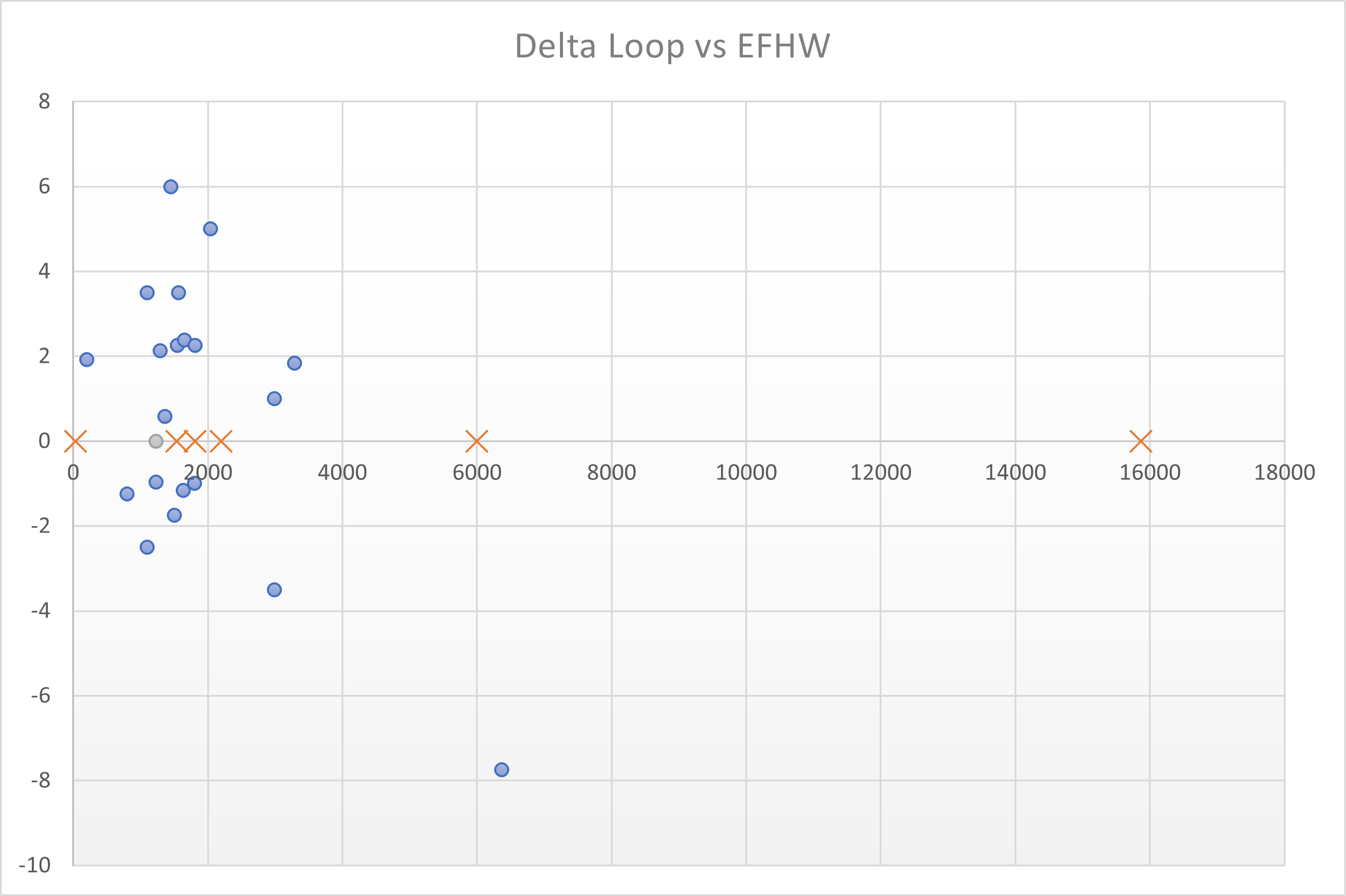

Blue points are the averaged differences between the signal reports of the same spotter for the Delta Loop over the EFHW. The spotters are plotted by their distance from me.

The plot shows that in EU to about 3000km the delta loop beats the EFHW at most spotters, although four spotters only heard the EFHW (orange cross) and the EFHW got more reports in total. So it would probably be hard to tell the difference between the two within EU during a field activity.

Outside of EU the story is a different one. There were three DX stations picking up the WSPR signals. W7, VE6 (6000km) and VK5 (15000km). The VE6 copied both beacons a couple of times but the EFHW was clearly stronger (by average 8dB). The W7 only copied the EFHW but only barely and once - so we will skip that one. The VK5 copied the EFHW 4 times without picking up the delta loop beacon. 

The delta loop deserves a bit more testing but at first sight I would choose the EFHW for both its performance and practicality.


Friday, October 27, 2017

Test: End fed wire versus AlexLoop on 20m

Recently I did some tests with my two WSPRLite beacons. I started testing my AlexLoop against a 20m long end fed wire on 40m. The wire beat the loop quite dramatically.

One of the comments I got was that the loop should do relatively better on higher bands. That is why I ran a test on 20m as well. I collected the data about 2 weeks ago but due to other commitments I only got around to analysing it today. 

So what was the set-up? As in the previous article, I set up the AlexLoop in the garden with the center of the loop at about 2 meters high. The end fed wire this time was 10 meters long and ran from the back of my house into the garden sloping from about 7m high to about 2,5m high. I ran the beacons on 200mW for 2 consecutive days. 

The WSPR data shows:

  • 514 spots from 49 spotters were received for the beacon on the wire 
  • 436 spots from 29 spotters were received for the beacon on the loop 

This already gives you some impression about the difference. More stations were able to pick up the signal from the wire. 

Looking at the spot map below (distance in km vs SNR) you can see the orange profile of the wire is slightly shifted to the right (higher SNR) as compared to the blue profile of the loop. It is not as big a difference as on 40m though. 
More prominently you can see that the odx is again much higher for the wire as the signal was picked up across the pond in East Coast US (orange spots on the top).


This time the overlap is bigger, which makes it interesting to zoom in on a single spotter to see the actual signal strength over time. I selected one spotter that generated the most spots (EA8) but did check if the profile was any different at other spotters. This seems like a good sample for those stations that heard both. The orange line shows the SNR of the end fed wire, while the blue one shows the loop. On average (also looking at other spotters) the loop is 3 dB down across EU.


There are not enough spotters to make further assumptions about performance differences at specific distances or directions. What you can see is that for DX the signal from the wire is received within a 6dB range of SNR. The loop is not reaching the lowest end of that SNR. So it seems the wire is beating the loop everywhere but more so on DX.

Saturday, October 14, 2017

Test: End fed wire versus AlexLoop on 40m

Recently I acquired two WSPRLite beacons. I want to use them to test various antennas to find out which ones are most effective /P. I have built a number of different antennas and I still have a few projects planned. Modelling antennas gives you an impression what to expect but you only find out in the field what the real performance is. Actually, you need (more or less) parallel reports to account for changing conditions and WSPR is a nice system to get these reports accurately. 


Two identical 200mW WSPR beacons
I started using the beacons at home testing the performance of my AlexLoop against my default antenna - an end fed wire. At home I use 20m of wire that is resonant on 10, 20 and 40m. That wire runs from the back of my house at approx 8m high to a corner of my garden and then still a couple of meters along the far end of the garden - sort of an L-shape. It ends at approx. 1.5m high. Nothing special - not your DX killer.

Although this is a convenient test for me to do at home, the comparison is not that exotic as both a low hanging and sloping end fed wire and a portable loop are realistic /P antenna options.

The first tests I used the AlexLoop in the attic on 20m, 30m and 40m. It turns out that although the loop is higher there, the attic itself attenuates the signal too much. It is just not picked up while I do get spots from the end fed wire. So I moved the loop to the garden at a height you would put it at when going /P - the center at about 2m high.


AlexLoop in the garden
I tuned the loop to 40m. Now spots were coming in for the AlexLoop. Running both beacons for 24h on 40m I can get a good picture of the difference between the AlexLoop and the (low) sloping end fed wire. 

Comparing the spots of the two antennas from the same RX stations, I find that the loop is mostly 10dB or more down from the end fed wire. That is an enormous difference. There is no advantage to be found on any distance for the loop.

Odx for the AlexLoop was EA8 with 3000km (2 spots from EA8) with 39 different spotters over the measurement period.
Odx for the end fed wire was N8 with 6500km (14 spots from W) with 110 different spotters over the measurement period.


The graph above shows the spots for the end fed wire (blue) and the AlexLoop (orange) on 40m over the same measurement period. The distance to the receiving station (in km) is on the vertical axis and the signal strength (in dB) reported by the receiving station on the horizontal axis. 

Apart from the two orange dots at 3000km (EA8) the AlexLoop does not reach much further than 1000km. You can also see that the end fed wire gets better signal reports - with significantly more dots to the right. 

So, my first test of the beacons worked out well and I have my first bit of data on two antennas. My idea is to create a separate section on this website dedicated to antenna performance based on future experiments with the beacons.