Showing posts with label dx. Show all posts

Monday, December 27, 2021

Enjoying better conditions as PG44FF

With Christmas approaching I had a bit of time available and I had already arranged a special call for the holiday season. Looking at the slowly awakening sun I was motivated to go out portable again on Dec 24. Normally I would go out somewhere in the afternoon and into the evening to get both some DX on the higher bands and lively conditions on the lower bands but Christmas Eve meant I had to be back home at 16h local time.

PAFF-0167

Trying to find a PAFF nature reserve that I had not activated before and that looked like it would allow me to set up my hexbeam (so not in the middle of a forest) I found one at 1.5h driving distance. Even though this would mean I would spend more time travelling than on the air I settled for it.

Setting up in the mudHexbeam looking towards OC

The weather forecast showed overcast but dry conditions. This turned out to be a but too optimistic. It was raining when I arrived at the nature reserve. The area I had selected to set up my station had turned into a big muddy pool. Still I managed to set up the hexbeam without getting everything covered in mud.

It was around 10.30 UTC so contacting the far east and perhaps even OC was theoretically still possible. So I started out on 20m with the hex pointing northeast. Skip within EU was a bit unstable but strong most of the time. After about 20 QSOs ZL3LF came through the pileup with a signal peaking at S8. A very nice surprise indeed. I called for more DX but got no reply however 6 minutes later VK2ON made it through the EU chasers with an S9. It shows that the band was wide open in that direction. I called OC a couple of times but it seemed everyone else was enjoying Christmas Eve away from the radio.

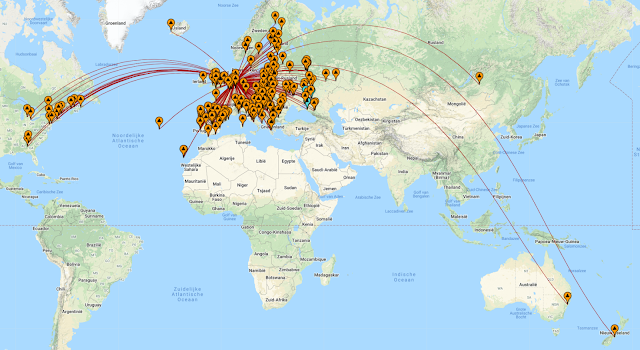
222 QSOs spanning the globe

It was busy all the time. In 2h20m I logged 222 QSOs in phone with chasers from a whopping 43 DXCC, 8 different W states and 3 VE provinces. 

I tried the higher bands but 10 and 12 were dead and even 15m did not result in more than a handful of QSOs. It would probably have served me better later in the afternoon. However the skip in EU was quite wide running all the way from 150km (still within PA) up till the edges of EU. So there was no real need to go down to 40m - which would have required changing antennas.

Nice wide skip in EU on 20m (orange = 20m, turquoise = 15m)

All in all again a pleasant activity and worth the 4h travel and setup time. HNY to all!

Tuesday, October 30, 2018

5b dxcc

This weekend I reached the "5 band DXCC" level. Quite a remarkable milestone considering the journey...

Where it started
When I came back to ham radio in 2010 I was eager to work as many DXCC as I could. I started with a shortened dipole in the attic - very far from ideal - but each and every country was a new one. Even with limited radio time my progress was smooth and I was happy for a while.

I upgraded my license in 2011 adding a load of new bands and with that the challenge increased: I would have to collect at least 100 DXCC on each (why?... I don't know, that is how addiction works).

My antenna changed into a wire behind the house running from 8m high to 2m high in a corner of the garden. An upgrade from my in-house dipole and an opportunity to add a few more DXCC.

Chasing /P
In the mean time I had developed a new addiction: activating WWFF nature reserves. Going /P inspired me to develop better antennas. Portable operations have their limitations (especially if you look at it from your multi tower station) but in my case I saw opportunities I did and do not have at my QTH.

From a mobile whip I quickly moved to vertical end fed antennas that already were more effective than the wire behind my house. And as time went by, adding more DXCC meant going out /P.

I took the opportunity of big contests - with lots of DXCC's active at the same time - to make my /P DX hunting as effective as possible. All the while trying to improve my /P station.

Beaming with delight
In 2012 I had one of my most pleasant chases when I went out with a 4 element beam for 10m (a band still open at the time) during CQ WW SSB . I added 24 atno's and 14 new bands, working a few hours on Saturday evening and a few hours the following morning. I don't think I have ever worked so many new ones in just two time slots.

Although the 10m beam was instrumental in the fun that time, it was also the first time I used the folding hexbeam that I just finished building in the week before the contest. This became and still is my favourite /P antenna. It has helped me work DX even now, at the bottom of the solar cycle.

With the hexbeam and a small mobile amplifier I added to my /P setup, I went DX fishing during a few other contests the next year. I scored 10 atno's and 22 new band dxcc during WPX in 2013 with the hexbeam, 4 atno's and 27 new band dxcc during EU HF contest  in 2013 and 6 atno's and 24 new band dxcc during CQWW SSB 2013.

3 band DXCC
By August 2013 I had logged more than 100 DXCC on three bands: 10, 15 and 20m. 17m was the candidate for the next 100 and I think I reached that somewhere in 2016 (time to play radio had been rather limited in the interim and I had not been out to actively chase DX /P).

By 2016 12m was no longer a feasible candidate to reach 100 DXCC as the sun spots had disappeared and I had failed to give that band enough attention in the preceding years. So my focus shifted to the lower bands. In 2016 I went out again during a CQWW SSB. This time focusing on 40m and 80m. I was only able to add 4 new DXCC to 40m, while adding 12 new ones to 80m and 28 new ones to 160m.

This left a challenge with still quite a few to go on 40m. The most feasible new ones required different operating hours than I could use from home (with the whole family asleep). So it looked like I needed another contest and /P operation. However I did not find the time. 

The final push
Then came last weekend with yet another CQ WW contest. I had not planned to be particularly active. There was no time to go /P but I did have some free slots to switch on the radio at home. Somehow I had brought my total to 96 DXCC worked on 40m in the meantime. With no expectations at all I started chasing some new ones I could hear. With the simple setup at home I could not reach all of them but with some persistence I was at 99 DXCC on Saturday evening. Of course this was not going to be the end result of the weekend. I continued my chase on Sunday in between other obligations and by the end of the day I was at 102 DXCC with an amazing JT and KL7 in the catch (thanks to their antennas).

Next up: 80m.. only 50 DXCC to go.


Tuesday, October 23, 2018

Testing my VDA on 20m

Last Monday I found some time - at last - to go out and do a proper test of the VDA I built many months ago. It is a 20m version and I only built it to test the effectiveness before deciding to build one for 40m - for which I don't have a directional antenna yet.


My 20m VDA
The only way - imo - to assess the performance of an antenna is to compare it to one or more (default) antennas at the same time. Conditions vary strongly by the minute, so you need an A/B type of setup. 

What I did was the following:

1. I set up the VDA on my 18m SpiderBeam pole with the feedpoint (at the bottom - as my VDA is end fed) at about 3m high.
2. I set up an end fed vertical for 20m with the feedpoint also approx 3m high.
Vertical at the picknick table
VDA with vertical in the background

I then performed three types of tests:

1. I ran 2 identical WSPRLite beacons for 90 minutes (0.2w output)  
2. I generated spots on FT8 with my FT857 (50w output) using an antenna switch and comparable feedlines 
3. I did some live SSB RX tests using the s-meter and one TX test (100w output) with the help of Timo OH7JHA.


One of the two WSPRLite beacons
I collected the WSPR data from the WSPR database and the FT8 reports from hamspots.net


Data collection (and some first impressions on the go)

Overall impression

Looking at all the data there is not an easy path to a final conclusion. So bear with me.
Especially the FT8 data seems to present a complex picture - where sometimes the vertical is the only one heard and then the VDA while they both have decent reports with that particular spotting station. My assumption is that the FT8 data is less reliable as the band was crowded at the time. I saw that I was often competing with other stations on the same frequency. For me that could explain why some of the patterns in the data seem to contradict / give inconclusive outcomes. 

In general I find that with 50w (@FT8) output the simple vertical generates more spots (is received more often). This makes sense as it is omnidirectional and the spotters can be found in all directions. With 0.2W (@WSPR) this is no longer the case as the omnidirectional signal becomes too weak to be picked up in many cases. In fact at one point the conditions had gone down and I received no spots at all with the vertical while still being spotted with the VDA (btw I swapped the beacons to be sure there was no influence there).


Looking at both the WSPR and FT8 data I can also see that the VDA almost always "wins" when the station is in the direction the VDA is pointing in (assuming a 60 degrees beam width).


WSPR results

Using only the WSPR data the VDA is a clear winner. The vertical only wins once and only marginally while the VDA was pointing in the other direction. There are a number of ties but when the station is in the direction the VDA is pointing in, the VDA wins 100%.
The VDA makes it across to PY (9000km), while the vertical only reaches EA8 (3000km). 

FT8 results

The FT8 data paints a less clear picture:
  • The VDA is the only antenna that reaches VK (multiple spots from VK2 and one from VK8 up to -13). 
  • When pointed towards JA the VDA creates a lot more spots than the vertical (from more spotters) but the overall SNR is only about 1dB better on average.
  • When pointed towards W the VDA is comparable to the vertical with only about 0.5dB better reports on average.
  • When pointed toward 4X the VDA clearly wins (5dB, 2 spotters) while it mostly loses when pointing the other way (as you would expect with a directional antenna).
  • In EU the VDA mostly wins when directed towards the spotter with the exception of EA (several spotters - maybe there was some obstacle in that direction?). However the VDA also loses sometimes or wins when it is pointing in another direction - which does not make sense if it is directional. It seems that in 1 skip distance the directivity is not as noticeable or other factors play a more important role (FT8 qrm, type of antenna used by the spotter, etc.).

"Live" results
The live data also gave some different outcomes. Testing with Timo - pointing the VDA to OH - gave no conclusive advantage (Timo reported an s9 on both antennas) while turning the VDA away only decreased the signal by 1 to 2 S-points. 
Listening around the band and switching between the two antennas increased my understanding of the difference in practice. When the signal was loud the difference was hard to notice.  However, when the other station was DX and weaker (FH, W) the VDA was up to 2 S-points stronger. I have made a short video of W1ZY/M station working with a mobile antenna, where - even though there is QSB - you can see the difference in RX quite well.


Conclusions

Getting more hard facts - so as to be able to make any claims about gain figures - would require setting up both antennas for a couple of days with the two beacons. Sadly I do not have the space to do that. 

So for now, we will have to work with what I have learned on Monday and by going through the data:

The VDA is not a miracle antenna. The theory (as I discussed here) shows that it should have around 3dB gain over the vertical I used as reference. Practice shows it has gain over the vertical that is noticeable (relevant) on multi-hop DX (eg with VK) and weaker signals but on shorter distances the effect is less clear. The data also shows that the VDA has directivity but I have not been able to assess how much that is.

All in all this to me is not enough to warrant a 40m version of this antenna. I will be taking this 20m version along on my future /P adventures as it does not take up that much extra space. If I learn more, I will share it.


If you have other experiences with this antenna or comments on the way I constructed or tested this one, let me know. I am always eager to learn more.


Tnx to Timo for his help and the many spotters (that were unaware of their support to this test).

Monday, November 20, 2017

Portable at PAFF-0117

Last week I had a rare opportunity to go out again /P for a longer stretch of time. I decided to head to the south of the country to activate a nature reserve I had not visited yet: Weerter- en Budelerbergen & Ringselven.

Because I had some time on my hands and I had not been on the radio for weeks, I went for the "full monty" - taking a hexbeam for the higher bands and a delta loop for 40m. I was not going to let the conditions ruin my day.

When I arrived at a lake in the nature reserve I was suprised to find a nice sturdy gate - placed by a local fishing organisation to corner off a piece of the lake. This made setting up the hexbeam a bit easier.

Alu mast nicely supported by a fence

There was some old metal pole a bit further away that was helpful for keeping my Spiderbeam 18m mast up. This mast was holding the full size delta loop for 40m. I had not used that in the field apart from some initial testing.

When the antennas were up I first collected J5 on two bands (atno for me) and TO2 on a new band. Then it was time to wake up the WWFF chasers.

Hexbeam at about 10m/30ft

I started on 40m as the higher bands were still rather quiet. QRM was manageable and the flow of chasers was quite constant - logging 116 calls in the first hour.

Then it was time to try 20m with the hexbeam pointing east. The first contact was a nice surprise: a VU2 who commented on my signal level - being 9+10dB at his end. I worked VU only a couple of times before so I was thrilled that he came to say hello and even more so that signals were that good. He was followed by a number of EU chasers. As the earth kept turning North America woke up. K1RO was the first one to make it across. It was time to turn the hex that way. Signals were never very strong but QRM was low on 20m, allowing me to work 23 stations from 15 US states and 4 VE provinces. Not bad at all.

In the meantime I was visited by a member of the local fishing club who wanted to know what I was doing. He made a minor point about me using their gate as a support but was satisfied after a short explanation of my intentions.

After a while I did not get any response on my CQs anymore and dusk was setting in. So I decided to take down the hex while I could still see what I was doing and continue on 40m until I had to leave. Before doing that, I called TI2 and logged him on a new band (17m).

Taking down the hex at dusk

Sadly 40m had turned into a very noisy band. It was hard to copy anyone at signal levels under s9. I did seem to put out a nice signal though as I saw a spot on the cluster from W3 and an OM from A7 (Qatar) came by to ask me what the heck my setup was, as I was that strong. The delta loop has made it into my favourite set of antennas. I logged another 60 chasers through the QRM.

In just under 4h radio time I logged 254 calls from 44 DXCC, 15 US states and 4 VE provinces. ODX was TI2 at 9100km.

Tnx to all the chasers that came by.

Sunday, April 9, 2017

Project - Changing a CB beam into a 10m beam


USING A CHEAP 11M YAGI TO GET A HIGH PERFORMANCE 10M YAGI
(originally posted in June 2012)

As blogged before I got myself a cheap 11 meter 4 element yagi (Sirio SY27-4). I am now in the process of making a manageable yet strong and high enough mast to use in a portable set-up as well as optimising the antenna itself.

Today I started using a modelling program called 4nec2. It took me some time to figure out how to use it but in the meantime I have modelled a few different configurations of the Sirio.

This is what the antenna radiation pattern looks like when used in its original configuration on 27.2Mhz


Horizontal pattern (original) 3d pattern (original)
The main figures for this original configuration @ 27.2Mhz: Gain: 8.39dB, F/B: 18.5dB and beamwidth: 60 degrees.

Paul MM0ZBH advised me to shorten all elements by moving all sections in by fixing them with only one screw (they are normally held by 2 screws per section). This means a reduction of the elements lengths by 8cm. This slightly changes the relative size of the elements (relative to eachother). So I was wondering what would happen to the radiation pattern. It looks like this:
Horizontal pattern (one hole shorter) 3d pattern (one hole shorter)
The main figures for this shortened configuration @ 28.45Mhz: Gain: 8.59dB, F/B: 13.9dB and beam-width: 60 degrees.

Gain is up a bit but F/B ratio suffered from this change. F/B ratio is however not a main concern for me in the portable set-up. To be sure that this configuration would be a good one I also compared this to a completely scaled down version of the antenna - changing the element lengths and boom position by x% based on the higher target frequency. The outcome of this exercise:
Horizontal pattern (scaled down) 3d pattern (scaled down)

The main figures for this scaled down configuration @ 28.45Mhz: Gain: 8.41dB, F/B: 18dB and beam-width: 60 degrees.

The F/B ratio is back up to 18dB. Gain is roughly the same. To me this does not seem like a worthwhile change as it involves adding new holes to the elements. It might be a good step when F/B ratio is relevant.

While researching antenna models I also came across a model designed by DF9CY. Christophe apparently also changed an 11m beam into a 10m one. The radiation pattern of his antenna also looks very good. The position of the elements along the boom is a bit different: the dipole is much closer to the reflector.

The radiation pattern of the DF9CY yagi:
Horizontal pattern (DF9CY) 3d pattern (DF9CY)
Christophe's version performance @ 28.45Mhz: Gain: 8.64dB, F/B: 16.3dB and beam width 60 degrees.
The performance looks a lot like the scaled down version of the Sirio. Christophe achieved a bit more gain while opting for a bit lower F/B ratio.

All in all this tells me that taking the Sirio and changing it by just moving all sections in by one screw hole leads to a very acceptable 10m beam that is hard to beat by any other configuration (if you take the 4m length of the boom as a given). The sigma match for this configuration needs to be 22cm extended for the SWR to be flat around 28.4Mhz.

Another advantage of taking the "one screw hole"-approach is that you can use it the other way around and create a rather decent 12m antenna. If you keep the boom positions as they are and move all sections of all elements out by one screw hole (from the original two screw connection) you get a 12m antenna that works as shown below.
Horizontal pattern (one hole larger, 12m) 3d pattern (one hole larger, 12m)
The performance @ 24.65Mhz: Gain: 7.61dB, F/B: 9.02dB and beam width 60 degrees.
This is not brilliant - especially the F/B ratio is low - but compared to my vertical wire this should deliver a better performance. The question is whether I will be able to tune this antenna using the standard gamma match. Will have to find that out later.

Note that all models above are based on an antenna in free space. If you take the chosen configuration for 10m ("one screw hole shorter") and put it on 6m height (what I am aiming for). You get the following performance:


Horizontal pattern Vertical pattern
The performance @ 28.45Mhz: Gain: 12.58dB (at 25 degrees), F/B: 15.4dB
At 15 degrees elevation (more relevant for DX) the gain is still 12dB. This should help me to get in touch with some DX.

Update November 2012: In the meantime I built the portable alu mast to hold this antenna. The mast goes up to approx. 13m (43ft) without the need for guying (even with the beam). I used this combination during CQWW SSB 2012. The beam was at that time around 11m (37ft) high. It then has a theoretical gain of 13.6dB at 15 degrees. Perfect for DX-ing on paper but also in practise. Check out my experiences here.

Monday, October 31, 2016

PH0NO goes vlogging

Setting up my /P station for CQWW this weekend I made some movies to give you an impression of what setting up that station entails. 

This one shows you how I set up my hexbeam. It is up on the mast (around 12m/40ft high) in 20 minutes.


Sunday, October 30, 2016

CQWW 2016 experiences

Logging a lot of new (band) ones on the low bands
As planned I went out this weekend to try and catch some new band DXCC - so not necessarily atno although I would have enjoyed that bonus.

My focus was on the low bands this time. I did take my hexbeam just in case there were new ones for me to catch on any of the higher bands. In retrospect it was not really worth the effort though. I logged one new DXCC on 20m and three on 15m. I learned I was too late as I could have worked more new ones on 15m but soon after I started (around 15h UTC) the band started to fade.

Apart from the hexbeam I took my recently constructed vertical that acts as end fed half wave on 40m and as a quarter wave on 80m with elevated radials. It turned out the end fed was resonant in part of the 160m band as well. I brought my tuner so I was able to use the whole band with that antenna.

An evening out on a deserted industrial area - hexbeam and vertical

Scanning the low bands
The low bands were noisy. The geomagnetic storm I experienced last Wednesday had settled a bit but it was still noisy. Another thing is that with a contest as big as CQWW the rather narrow bands are one big splatter party. This is especially true on 40m.

After spending time on 15m and 20m, logging only a handful of contacts, I turned to 40m around 15:30 UTC. There was not a lot to chase there, so I went down to 160m. It was early for that band but it was easy as I did not have to change anything when switching between 40m and 160m. For 80m I had to change the antenna setup slightly so it took some time to switch to and from that band.

Using my laptop with HRD Logbook I was able to monitor the cluster and see where I could find new ones. HRD shows you whether a DXCC that is spotted is already in your log for that band. Based on that information I switched between the bands. Unfortunately my laptop battery died at some point. I did bring an external battery but forgot the cable. I then relied on just listening around and on the cluster app on my phone. The downside is that I just cannot remember what DXCC I worked on what band.

Moving around across the bands I logged 69 contacts in 12 hours. Not particularly impressive during a contest (I suspect some stations managed more contacts in that period). However they contribute 44 new band DXCC to my collection.

Experiences per band
My 40m antenna was working as I expected. It is not a miracle antenna but I could work what I could copy. This included PY, a new one and the ODX on this band this weekend. I logged him when I had taken down the hexbeam and just wanted to check the low bands for the last time before taking down the vertical. I was happy with that catch. There is however a lot I cannot hear that others apparently can hear - judging from QSOs where I can only copy one side. This vertical end fed is clearly not a match for a beam. Conditions weren't particularly good and QRM was incredible, so I only logged 4 new DXCC on this band. I had hoped to log more new ones to move towards my 5th 100+ DXCC. I was counting on skip to the Caribbean but I only worked 8P.

My 80m antenna was better than I expected. The quarter wave relies on the ground system to work and with only 4 rather short elevated radials I was not expecting a lot. But again I could work almost everything I could hear. ODX this weekend was A6 at more than 5000km and I logged 12 new DXCC on this band. Note that I don't use this band at home and I had only logged 37 DXCC before (mainly on one evening and night in the snow when I joined the PACC for the first time).

On 160m I had only worked one station so far since I got my full license - some nearby german super contest station on CW on a shortened 40m wire antenna. This of course meant that almost all stations I heard were new DXCC on that band. The antenna was resonant but very short for this band (20m). I could work more than I expected but could not work everything I could hear. I noticed some stations had difficulty copying me while I could copy them without a problem. So there is still a lot to improve for this band. Starting with only 1 DXCC this was of course the best scoring band. I added a whopping 28 new DXCC here. ODX on this band was a respectable 2900km into 5B4.


Thursday, April 17, 2014

Hexbeam on short /P activities

If you are wondering: "is bringing a hexbeam to a short portable operation worth my while?", then this post is for you. It has become a bit lengthy.. so bear with me.


Over time I got numerous questions about the hexbeam I am using when working portable. The hex is a 2 element beam on 6 bands and allows me - especially if I bring a little heater with me - to put in decent signals even to very remote locations. A lot of answers about this wonderful antenna can be found in previous posts (start here). Here I want to go into the ROI of bringing the hex when time is limited.

The goal
Last Wednesday I had some time in the morning to go out /P. It is my day off and the kids are in school the whole morning. I have several options to spend this morning:
1. Do anything but play radio (duties around the house, work I haven't finished, etc.)
2. Play radio at home (using a sloping end fed wire)
3. Play radio /P

Pick your antenna
When I decide to play radio /P, I again have a number of options - like do I go out to fish DX or do I go out to activate a castle or a nature park?

When I decide to go out to fish DX the antenna becomes an important subject. My favourite antenna is the end fed half wave wire antenna put up vertically on a fibreglass mast. It is easy to bring and easy to deploy. It is also amazingly effective, allowing me to work DX around the globe as long a conditions are good and pileups not too large. It is also a very practical antenna in that you don't have to turn it. On the other hand it only works on one band - so switching bands means taking down the pole and changing wires. 
If you look at DX effectiveness however a beam is the best option (hands down). I have two HF beams at my disposal: my 4-el for 10m and my hexbeam. The hexbeam is of course the most versatile of the two, supporting 6 bands.

This effectiveness comes with a price however: the beam requires me to bring more stuff (like a heavy mast) and takes more time to set up.

Investment side of the ROI
Now we arrive at the main question: is it worth my while to bring a hex when I only have a short period of time to be /P?

For me the net radio time on Wednesday morning = 3,5 hours minus (time to pack and unpack the car + time to drive to a place and back + time to set up and break down the station). Packing and unpacking is about 20 mins in total, driving takes about 20 mins (back and forth). So just under 3 hours left.
The choice of antenna does not impact this a lot so far - just a few minutes to get the heavy mast and support stuff (un)loaded.

How much of the 3 hours I can be on the air depends on the time I takes to set up the station and break it down again. How is that with the hex? To give you an impression I timed the breaking down of the station. Below you will find the visual story of breaking up the station, driving home and unpacking everything.

Breaking down the station turns out to take 20 minutes. Setting it up will be about the same - although pushing out the mast probably takes one or two minutes more. So all this takes 40 - 45 minutes off of my radio time. 3,5 hours time leaves me just over 2 hours of radio time.

Okay, but what is the impact of the hex?
It turns out the hex itself now takes me 8 minutes to fold together and stow away (that is after a bit of practise). The mast and support take about the same amount of time to end up in the car. Setting up should be approx. the same amount of time - pushing out the mast is maybe a bit more time - so 35 minutes is the time the hex and mast take setting up and breaking down again (the other 5 - 10 minutes go to setting up and afterwards packing the radio gear, cables, etc).
Compare this to an end fed on a fibreglass pole. I can set that up and break it down again in less than 10 minutes. So, the investment is about 25 minutes of costly time.

Effectiveness: the return on my investment
So I went DX fishing. Good for me. Did I catch anything?
Vlad UA4WHX was on the move again. This time he was working from Easter Island (CE0Y) - a new one for me. Even though there were more people out there trying to get in the log I was able to work him on 17m and 20m (simplex). In the mean time I had a QSO with Garry VK5ZK, who was busy with a lot of EU stations calling him. He put in a good signal over the long path with his 400w and 3 element SteppIR but he also expressed his amazement at my signal while /P. Then I saw A35X on the cluster - another new one for me. After some 8 minutes I was in the log. Before going home I tried another A35 station but the operator was not very effective at crowd control and moved to CW after a couple of minutes.
So.. DX fishing I added 2 new ones to my list (which is already above 200 - so it is getting more and more difficult to catch new ones). Average distance covered was well above 16k km.

Is that worth 25 extra minutes.. ? "hell yeah".

Taking down the hex in pictures


Fully functional DX station (t = 0)
Mast collapsed (t = 4 min)
Hex partly folded (t = 8min) Hex folded to a small package (t = 12 min)
Everything neatly packed in the car (t = 20 min) Back home and unpacked (t = 35 min)

Sunday, March 23, 2014

A long activity from PAFF-056

Last Friday afternoon I went to PAFF-056 as planned. Weather turned out okay so I brought a couple of antennas, including my hexbeam. The plan was to activate the park and catch some DX in the process.

Long setup time
Setting up took more time than usual. This was caused by a bit of damage control I still had to do after the mast crashed down during the PACC contest.  Of course there was a new mast support to install and I brought my C-Pole for 40m for the first time.

I arrived in the reserve at 15h local time but logged the first contact only at 16h - J8 on 20m for a new band DXCC. After listening around for other DX I only encountered VU4 but the zoo was enormous - not something I was going to waste my time on.

Just before 16:30 I started calling CQ on 20m using my mono band End Fed (vertically on a fibreglass pole) and my Hexbeam pointing towards NA. After about one hour things started to quiet down and I scanned the bands for new DX to catch. I found 3B8 on 10m and added that one to the log to reach 200 DXCCs. One of the targets for this year but clearly not very a very ambitious one.


Setup with hexbeam @10m and end fed
Weather was improving during the afternoon

Tuning my new C-Pole for 40m
Then it was time to go down to 40m. This was a time consuming switch as the new C-Pole antenna I brought turned out to be a bit too short. I tried it above my roof at home one night after constructing it and there it was okay, but having it in the field and on a different height clearly has a lot of effect on the resonance frequency. I do not take any tuning devices with me when I go /P as I am careful to always take resonant antennas (I do not like the idea of wasting valuable radiation energy when /P) so I had to fix this - it was resonant around 7.4Mhz, "slightly" off.
Fortunately I brought extra wire and randomly added some lengths to both legs of the folded dipole. With some luck I got it to resonate in the relevant portion of the band.

With a resonant antenna I was ready for some serious WWFF activity again - 40m is always a popular band for WWFF chasers in EU. However it turned out the band was a terrible mess. It was crowded and QRM was S8-9 all over the band with a spiking signal (electric fence?) every second of 9+10. Great!
I logged 5 contacts before giving up and returning to a higher band - 15m this time using only the hexbeam.

15m was not particularly busy and was slowly closing while it was getting dark outside. I was planning to go back to 40m hoping the QRM would die out a bit. Before that however I packed up the hexbeam and all other stuff I was not going to use and definitely would have a hard time finding in the dark.

Trying 40m for a second time with a nice surprise
Around 20:20 local time I was back on 40m but to my disappointment it was still one big sea of QRM all over the place. However there were quite a number of strong signals (above QRM level) around so I gave it a try anyway and logged 56 contacts in the following 40 minutes.

Half way during this session on 40m a very peculiar thing happened. I got a call from a station that I heard to be something like ?K7AC. Now you have to imagine that it was a terrible QRM mess and that I had been logging EU contacts only. So I initially thought it was IK7AC - although the OM was definitely not Italian. When he repeated his call a couple of times I could only conclude that it was VK7AC - peaking S9 with me. He gave me 57.

Before this contact my ODX on 40m was TG - just a bit over half the distance - that I worked using my full size inverted V (my favourite DX antenna on 40m until this day) and more power - 300 in stead of the 90W I was using now. A nice surprise that completely wiped out my frustration about the band condition.

At 21h I called it a day - completely exhausted from pulling stations through the constant noise. I packed up the last bits and went back home.

All in all I logged 175 contacts from 40 DXCCs, including a lot of familiar call signs and some fellow FF national coordinators. Noteworthy DX included - VK7 (duh!), 3B8, 5R8, J8, ZS6 (on the side of the hexbeam) and a couple of stations in central USA. Not as much as I hoped to catch with the extra hassle of installing the hexbeam but enough highlights to travel home satisfied.

Monday, October 28, 2013

Results of CQWW 2013


Saturday I went out for an afternoon and evening of DX fishing in the CQWW contest. Setting up my rather elaborate /P station - see previous posts - took more time than during the last test on Wednesday. The wind was to blame.

Windy conditions
Aiming for DX I was a bit too enthusiastic and started with a fully extended mast. With both antenna's on it (yagi and hexbeam). The last section however is not strong enough in windy conditions. With the whole construction up I saw it rocked far too much and no guying was going to help.
So I took the mast down again, removed the yagi and lowered the upper section.
All in all it took me more than an hour to get the station in the air. The mast was a little lower than I hoped (hex at approx 11m and yagi at 9m) but it stayed upright and was still turn-able while guyed.


Double beam /P operation

Starting on the high bands
At 13h local time the hunt started. With my cluster app and two fellow hams - PD7YY and PA3GGI - online via WhatsApp I was able to find quite a number of new band DXCCs and even completely new DXCCs. I hopped around over the bands using the yagi for 10m and the hex for all others. The yagi pointed in the opposite direction from the hex, so I was able to quickly determine SP/LP paths on 10m by switching between the two antennas.

From the ones I actually heard I in the end missed three: VP2M (pileup too large and then gone) and FO4 (faded while calling by number) for new one all band and 7O on 20m for new band (lost in splatter). See the list and map at the end of this post for the total score.


Going down to 40m

Around 22:30h 10m was closing and I did not notice any new ones any more on the other bands so I took down the mast and antennas. At 23:30h however I was still not ready (mentally..) to go home so I set up my inverted V for 40m. This is a challenging band for DX in almost all cases but definitely when you are /P. Before this day my top DX on this band was KP2 (7000km) from home with a shortened dipole abt. 4m above my roof, followed by one US station from NJ (6000km) using my sloping wire and then R9 stations less than 5000km away. I did work some more US stations but only digitally and all at < 6500km.

So I was very happy when I added to W3LPL (6300km) as the first station on 40m this evening and even more happy - not to say ecstatic - when I added B9 (6500km and new DXCC on this band). Then I tried to hunt TF (new one as well on this band) but the pileup was too large as every serious contester was looking for zone 40. When I came back later he was gone but to my total surprise the station that was on his QRG and actually copied me was PJ2T. Brilliant! New max distance on this band with almost 8000km. I added a few more US stations and RW0A to complete the DX hunt on this band. I did manage to log TF later and added new DXCCs on this band from A7, 9K and HZ.

At 1:00am I ended the operation for the day planning to return in the morning to look for some remaining new ones on the higher bands.

No portable activity on Sunday
Sunday morning the weather had deteriorated however. As I was quite happy with the results of Saturday and not looking forward to getting extremely wet while setting up a large antenna in windy and rainy conditions I decided to stay home and work some more stations with my sloping wire (end fed). With this minimal set-up I just scanned the 10, 20 and 40m bands and called whoever I heard - handing out some points. I added two new band contacts with 7Z on 20m and XP on 20m (PSK).
Most of the contacts were in EU but I did manage to work US into W7 and even KL7 on 10m and 20m.

Pleased with the results
Map of stations logged during CQWW 2013
The map above shows the contacts in this contest. Green dots are 40m contacts, yellow ones 20m, orange 15m and red 10m. There are also three pink ones of WARC contacts. Together with the PSK contact (yellow star) with XP they are the new band contacts I made outside of the contest.

The total score this year is 6 new ones (all band - 5H, 7O, C6, OA, TI & XW) and on top of that 24 new band ones: 7 new on 40m, 9 new on 20m, 2 new on 17m, 7 new on 15m, 1 new on 12m and 8 new on 10m.

Thursday, October 24, 2013

Portable set-up with two beams

Yesterday morning I had some time to go out again to do some /P-DX-hunting and some lasts preparations for CQWW.

With 10m open as it is at the moment (yeah!) I decided to bring both my DX antennas: my 4 element yagi for 10m and my 6 band hexbeam. My idea was to try both to decide what I would bring next weekend to my CQWW chase. 

I tried to set up both antennas on my aluminium mast to do some A-B testing. It turns out my home-brew mast is sturdy enough to carry both antennas.  The hexbeam was on top (due to its construction it must be - it inserts into the upper tube of the mast) and the yagi some 2-3 meters below it. I used one guy wire just to be sure the mast would not bend too much, but in fact it was not really a necessary addition - even though it was a bit windy.

Stack: yagi and hexbeam - leafs are an indication of the windy conditions
This gave me a set-up that looks very impressive (to me as the ham-without-a-beam-at-home at least) and turned out to be effective as well. Being limited in time and of course using this opportunity also to catch some DX, I did not do a lot of A-B TX tests - it is quite bold to ask that DXpedition to give two real reports. One JA OM told me there were some 2-3 S-points difference (in favour of the yagi). Closer by a UY OM saw less difference. So there is still some testing to do. On RX however I could test the difference all the time. Here I saw that the yagi even when positioned lower is one S-point stronger. This is especially noticeable on the weaker signals. There you could really hear (as well as see) the difference.

Portable set-up: hex at approx 12m, yagi at approx 9m high
During the short period I was actually on the radio I managed to log DX from TN2 (new band), HS0, B9, JA3, R0 and D4 (new band).

What I learned for the contest this weekend is that it is useful to bring the yagi to catch the weaker DX (assuming 10m is open for a considerable amount of time). I also learned that I can have both beams on my mast at the same time. This gives me another nice opportunity: if I point the yagi and hex in opposite directions I can quickly check short path versus long path propagations on 10m. That is a feature that helps me as I am not used to working with a beam and therefore have too little experience to choose the right path given the direction and time of day.

Looking forward to more fun this weekend.


Monday, October 21, 2013

A few hours fishing DX - catching new ones


After two months in which I had no time at all for any radio-activity (imagine that...), I managed to free up a couple of hours on Wednesday afternoon. With about 4 hours I had just enough time to go out with the hexbeam and look for some DX.

Conditions had been OK in the preceding days, with openings on the higher bands (10-12m), so it looked like a good investment of my time. Taking the hexbeam out does limit the time left for actually being on the air as I have to bring more stuff and need more time to get it all set up (and broken down again). All in all I think I need about 1,5 hours to get all stuff in the car, drive to my favourite location, set up the station, pack everything in again and drive home. This left me with 2,5 hours to be on the air.

Looking through the glass roof of my car at the Hexbeam

DX with a couple of new ones
When I had my station ready I saw Dervin PD9DX was working from YB0 on 15m. I know Dervin from the PAFF program and he put in a very good signal. Enough reason to give him a shout and have a short chat. After that first contact I was scanning the bands and the cluster for DX activities, logging a total of only 12 contacts but interesting ones.

It turned out to be a nice DX afternoon, even though conditions weren't especially good. I worked a couple of new ones: C8, H7, FR and TN (Dutch DXpedition), two OD stations on two new bands (15 and 20), and a new prefix from Canada: CK1.
Noteworthy but not new were TO2 on 10m (already worked that one during WPX earlier this year), VK4 and YI1 on 15m.

One very peculiar thing: I worked TN on 12m long path... I still do not understand it. The signal was S0 sometimes peaking S1 on short path. When I turned the antenna around while looking at the S-meter I saw it peaked S3-4 when the antenna pointed north. I tried turning the antenna around a few more times, with the same result. Go figure.. TN is 6000km due south from here.

There were two stations I tried but did not reach:
- VP2, he was not very strong and there was quite a considerable pile-up. He did hear me once, asking for "the NO/P" station to come back but he consecutively answered a French station that called over me. I do not understand operators that do not manage their pile-up. It promotes selfish behaviour of chasers.
- V6, was very weak (S0-1) and had a large pile-up. No chance there.

There was also a VK5 station working from an IOTA location. He however had a zoo from "5 to 10 up".. so I skipped that one.

This was a nice exercise in preparation of CQWW - my next radio opportunity. I already booked time off family duties well ahead and have so far still managed to keep the claim on Saturday afternoon and evening and a part of the Sunday morning. So I will have some serious time to go out with the hex and I will probably bring my 4 element yagi for 10m as well.

Looking forward to more DX!